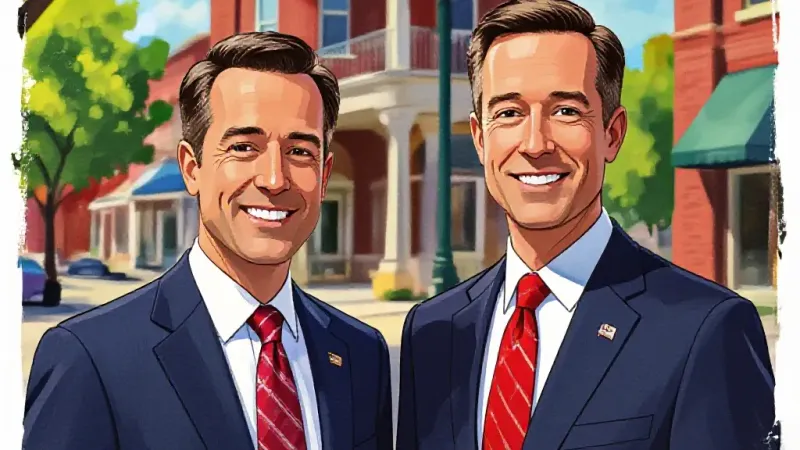
Democrat Beau Bayh and Republican Max Engling, both vying for Indiana’s secretary of state position, agreed on one central point during their final debate Thursday: the need to investigate the outgoing incumbent, Diego Morales. However, the candidates offered contrasting visions for how such an investigation should proceed.
Morales faces accusations of misusing taxpayer funds, including spending on luxury vehicles and promotional materials, hiring family members, and awarding no-bid contracts to donors. Bayh stated that a central promise of his campaign is to conduct an independent audit of the office, proposing to hire Knox County Clerk David Shelton, a private investigator and Republican, to lead this effort.
Engling, who entered the race after Morales declined to suspend his campaign, argued that any investigation should be led by the inspector general to ensure the full authority of the state is applied. He described Shelton as a “friend” of Bayh’s and questioned Shelton's ability and authority to compel state officials to cooperate or to investigate numerous individuals and documents effectively. Engling emphasized the necessity of having a person with the authority to compel documents, review emails, and investigate extensively to ensure proper conduct or accountability.
The debate, hosted by FOX59 and CBS4, also saw candidates exchange critiques on other topics, including their residency, driving records, campaign contributions, and ethics pledges. Libertarian nominee Lauri Shillings and Lincoln Party candidate Greg Ballard were not invited to the debate, as they did not meet qualifying polling thresholds. Bayh indicated that Engling had declined to sign a statement supporting their inclusion, while Engling asked the moderator for clarification on their absence.
Both Bayh and Engling pledged to serve a full four-year term if elected, committing not to resign early to pursue higher political office. They also agreed that the secretary of state's office should not be used for partisan purposes. Bayh asserted he would continue to support candidates and causes he believes in but would prevent such support from influencing his decisions in office. Engling, conversely, expressed that voters expect elected officials to "link arms" and "move the state forward."
On the issue of voter fraud, Engling reiterated his support for the SAVE America Act, which aims to verify the citizenship status of voters. He suggested he would collaborate with state lawmakers to implement color-coded state IDs to prevent legal noncitizen residents from using them to vote, stating, "One illegal vote is too many." Bayh, however, proposed working with county clerks to identify and remove ineligible voters from the rolls. He criticized state officials for prosecuting only one of the 21 noncitizen voters identified in a recent review, emphasizing the need to hold people accountable when they are caught.
Both candidates expressed support for Indiana’s existing voter identification law to secure elections and agreed on extending early voting hours to increase participation. However, they diverged on the concept of citizen-led ballot initiatives. Bayh expressed a desire to work with lawmakers to bring such initiatives to Indiana, suggesting it would boost voter turnout by giving citizens a direct say in issues like partisan gerrymandering. He stated that some Statehouse officials are "too often looking out for the special interests."
Engling opposed citizen-led initiatives, arguing that "dark money groups" in other states use them to bypass lawmakers and often mislead voters. He stressed the importance of trusting voters but also utilizing elected representation in the General Assembly to make laws through regular order and the committee process.
The debate also included personal exchanges. Bayh defended his father, former governor and U.S. Sen. Evan Bayh, against Engling campaign ads that he claimed "baselessly link him to a known pedophile with no evidence" (Jeffrey Epstein). Bayh stated his father never met or spoke with Epstein. Engling, in turn, claimed his team is in the process of suing Bayh for defamation regarding a political advertisement that he said misconstrued decades-old speeding tickets as reckless driving convictions, asserting that Bayh is the only candidate on stage charged with reckless driving.
Both candidates highlighted their Hoosier roots amidst questions about their time spent outside Indiana. Engling stated he moved from rural Illinois to Indiana as a teenager, attended Ivy Tech and Indiana University-Purdue University Indianapolis, and, after working in politics in Washington, D.C. for over a decade, returned to Indiana with his family. Bayh, a seventh-generation Hoosier, noted he moved to Washington, D.C., when his father was elected to the U.S. Senate and served in the Marines overseas. Both candidates expressed a desire to return home to Indiana.