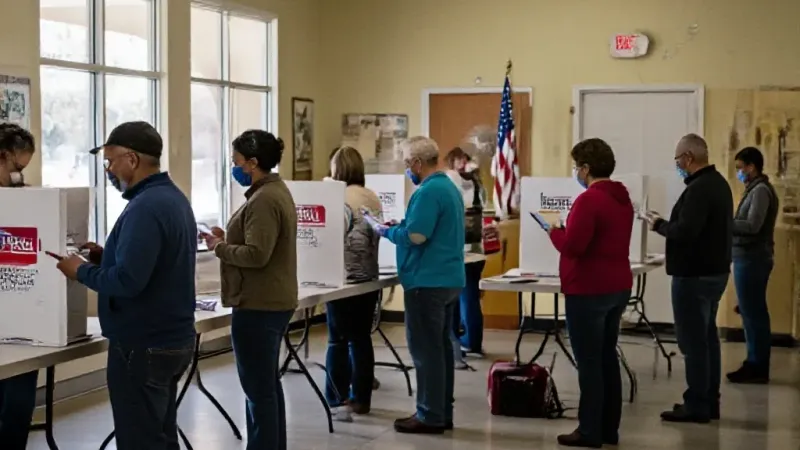
All nine Indiana members of the U.S. House are defending their seats this fall, with challengers offering competing plans for healthcare, household costs, and federal spending as voters help decide control of Congress. Seven Republicans and two Democrats are up for reelection under the same district boundaries lawmakers approved in 2021. The general election pairs veteran lawmakers with challengers from local government, education, business, and other professions. Early voting for the contests began on Oct. 6, with Election Day set for Tuesday, Nov. 3. Polls will be open from 6 a.m. to 6 p.m. local time. Voters can find their polling places and ballot information at IndianaVoters.in.gov.
Perhaps the most competitive of these contests is in the 5th district, which stretches from Hamilton County’s suburbs to communities including Anderson, Muncie, Marion, and Kokomo. Here, Democratic state Sen. J.D. Ford is challenging Republican U.S. Rep. Victoria Spartz. Spartz, first elected in 2020, is seeking a fourth term, having previously served in the Indiana Senate. Ford has represented Senate District 29 since 2018 and became the General Assembly’s first openly gay member. The Democratic Congressional Campaign Committee has designated the 5th district as a target district “in play” for the election. The candidates have sparred over having a debate and television ads Spartz called inaccurate.
Both Spartz and Ford emphasize healthcare costs and government accountability but propose different approaches. Spartz supports spending reductions to balance the federal budget, changes to legal immigration and work visas, and greater transparency and competition in healthcare, stating that “Our healthcare costs are unsustainable.” Ford’s platform calls for restoring and protecting Medicaid funding, preserving rural hospitals, and protecting reproductive freedom. He also proposes restricting home purchases by large corporations and international investors, requiring data centers to cover their own water and utility expenses, and holding regular town halls. The candidates were on opposite sides of last year’s redistricting fight, with Spartz supporting the effort and Ford voting against it.
In Northwest Indiana’s 1st district, Democratic U.S. Rep. Frank Mrvan faces Republican Barb Regnitz. Republicans are again seeking to capture one of the state’s two Democratic-held congressional seats here. Mrvan, a Hammond native and former North Township trustee, is seeking a fourth term. Regnitz is a Porter County commissioner whose background includes software engineering and financial planning. The National Republican Congressional Committee added Regnitz to its MAGA Majority program in July. Mrvan’s campaign platform emphasizes federal investment in the region, union jobs, and reproductive rights, including putting abortion protections into federal law. He points to infrastructure funding and Medicare prescription-drug price negotiations as parts of his record. Regnitz’s platform calls for stronger border enforcement, reduced federal spending and debt, and greater support for law enforcement. She also proposes limiting mail-in ballots to rare, verified exceptions and using watermarked paper ballots for in-person voting. For affordability, Mrvan emphasizes federal investment and healthcare savings, while Regnitz argues that spending restraint and curbing inflation would strengthen families’ purchasing power.
North-central Indiana’s 2nd district, which includes South Bend, Elkhart, Goshen, and Warsaw, sees Republican U.S. Rep. Rudy Yakym against Democrat Jamee Decio and Libertarian William Henry. Yakym has held the seat since 2022 and is seeking another term on a platform of limited government, lower taxes, and reduced regulation, highlighting border security and safe communities. He stated that “government should be accountable, transparent, and focused on its core responsibilities.” Decio, a South Bend lawyer and former Elkhart County deputy prosecutor, emphasizes lowering everyday costs, protecting Medicaid and Social Security, and requiring data center developers to bear their own costs, along with supporting local control and community input for such projects. Henry, an Elkhart communications professional and military veteran, advocates reducing federal spending and regulation, improving veterans’ care, and protecting medical privacy. On the region’s manufacturing economy, Decio has criticized tariffs’ effects on the recreational vehicle industry, while Henry supports workforce training and economic diversification.
In northeast Indiana’s 3rd district, Republican U.S. Rep. Marlin Stutzman faces Democrat Kelly Thompson. Stutzman, a farmer and business owner from Howe, returned to Congress after winning election in 2024, having previously served in the Indiana House and Senate and the congressional seat before a 2016 U.S. Senate bid. His campaign platform emphasizes reducing federal spending, strengthening border security, protecting gun rights, limiting federal involvement in education, and small-business growth. Stutzman told the Capital Chronicle he supports another redistricting effort. Thompson, a concrete contractor and nonprofit founder from North Webster, is campaigning on wages, housing, healthcare, and government accountability, with calls for Medicare for All, a ban on stock trading by members of Congress and the president, and greater accountability for corporate polluters. She opposes redistricting, arguing lawmakers should focus on existing constituents.
West-central Indiana’s 4th district, including the Lafayette area, Crawfordsville, and Greencastle, features Republican U.S. Rep. Jim Baird against Democrat Drew Cox. Baird is seeking a fifth term. A farmer, small-business owner, and Vietnam veteran, he previously served as a Putnam County commissioner and state representative. In an April questionnaire published by Based in Lafayette, Baird identified lowering costs and securing the border as priorities. He proposed reducing federal spending and regulation, supporting energy independence, and strengthening immigration enforcement. On healthcare, Baird advocated competition, telehealth, and fewer regulatory barriers, stating he would “support policies that empower patients and providers.” Cox, a Purdue University music instructor from Lafayette, emphasizes healthcare access, workers’ rights, veterans’ services, and reducing the influence of money in politics, stating his campaign refuses corporate political action committee donations and supports overturning Citizens United.