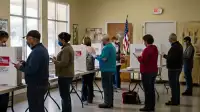
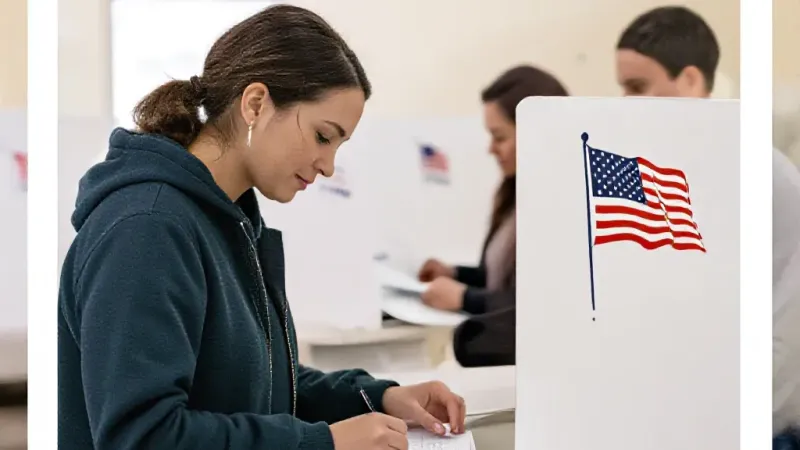
As Hoosier voters head to the polls this election, they will encounter questions on their ballots regarding the retention of judges for the Court of Appeals of Indiana and the Indiana Tax Court. Many residents in Terre Haute, Vigo County, and the wider Wabash Valley may find themselves uncertain how to approach these decisions, potentially due to unfamiliarity with the courts' roles or the criteria for evaluating a judge's performance.
This year, three judges from the Court of Appeals of Indiana and the judge from the Indiana Tax Court are up for retention. Appellate Judges Mary DeBoer and Paul Felix will appear on every Hoosier voter’s ballot statewide. Judge Dana Kenworthy will be on ballots exclusively for voters in counties within the Court of Appeals’ second district, which includes Marion, Hamilton, Tippecanoe, Delaware, and Howard counties. Indiana Tax Court Judge Justin McAdam will also be on every ballot across the state.
Voters will be asked to answer "yes" or "no" for each judge. A simple majority vote is necessary for a judge to remain on the bench. If a judge is not retained by the electorate, their tenure will conclude when the Indiana secretary of state issues a certificate verifying the outcome, which must occur no later than the first Friday after Election Day. Judges who are not retained can request a recount, which would allow their term to continue until the Indiana Recount Commission certifies the electorate’s vote against retention. Any vacancy created by a judge not being retained would be filled through the Judicial Nominating Commission's merit selection process, which involves submitting three nominees to the governor for appointment.
Former Court of Appeals Judge Linda Chezem advised Hoosier voters to read the opinions written by the judges. She acknowledged that this process requires time but stressed that decisions made by appellate and tax court judges impact the entire state, regardless of the specific parties involved or where a case originated. Chezem dismissed the notion that non-lawyers would struggle to understand written judicial opinions, stating, “You don’t need a law degree to have common sense.” She added that people should not be intimidated by a judge's position.
For voters seeking additional information, the Indiana Supreme Court’s Office of Judicial Administration has developed a judicial retention website. This online resource provides biographical information, videos of oral arguments, and direct links to each judge’s written opinions. Furthermore, the Indiana State Bar Association (ISBA) has released its survey results, indicating that a sizable majority of its members support retaining all four judges. ISBA members, who include lawyers, judges, law school professors, court administrators, and paralegals, were asked for their opinions on each judge's retention.
The Court of Appeals of Indiana serves as the state’s second-highest court, hearing most cases appealed from trial courts and some state agencies. Established by the Indiana General Assembly in 1891, it was initially created to help manage a backlog of cases awaiting adjudication at the Indiana Supreme Court. Currently, 15 judges serve on the appellate court, representing five districts. Each case is randomly assigned to a three-judge panel, which reviews facts and legal arguments before making a ruling. Most decisions are based on filed briefs and trial court records, with oral arguments being uncommon. The court issues more than 2,000 written opinions annually, which are noted for their detailed explanations of how panels reach their decisions.
The Indiana Tax Court, established by the legislature in 1986, operates with one judge. This court hears appeals of decisions made by the Indiana Department of State Revenue and the Indiana Board of Tax. It also holds jurisdiction over some appeals originating from the Department of Local Government Finance.
Judge Chezem further suggested that voters not only read opinions but also investigate any dissents judges may have written, noting, “I consider dissents to be very important.” She explained that dissenting opinions, which arise when a judge disagrees with the majority due to a differing interpretation of law or precedent, can sometimes encourage the Indiana Supreme Court to review a case.
Joel Schumm, a professor at Indiana University Robert H. McKinney School of Law, cautioned voters against basing retention decisions on a single written opinion, considering that Court of Appeals judges decide hundreds of cases annually. Schumm advised voters to evaluate judges based on whether they work diligently, treat people with respect, and write well-reasoned opinions. He highlighted the ISBA survey as a “useful tool,” given that its respondents include legal professionals who have direct experience with these judges. Schumm indicated that a default “yes” vote for many voters is not a negative outcome, expressing hope that any significant issues with a judge’s behavior or rulings would become widely known.
Biographical details for some of the judges on the ballot include:
Judge Mary DeBoer was appointed to the Court of Appeals by Gov. Eric Holcomb in 2024. While serving on the Porter County bench, she established two problem-solving courts for juveniles: a truancy court and a transformation court focused on mental illness. She also developed an Immersion Through the Arts Program designed to connect youths struggling with delinquency with local mentors. DeBoer has served on the Indiana Judges Association Board of Managers and is currently a member of the Appellate Practice Section Council of the Indiana State Bar Association. She chairs the Criminal Case Flow Management project, which examines and identifies strategies to enhance criminal case processing statewide. A native of Kalamazoo, Michigan, DeBoer graduated with honors from Western Michigan University and earned her J.D. degree from Valparaiso University School of Law in 1993.
Judge Paul Felix was appointed to the Court of Appeals by Gov. Eric Holcomb in 2023. He served for over a decade as a deputy prosecuting attorney in the Johnson County Prosecutor’s Office, where he created the county’s first Domestic Violence Unit and led the prosecution of domestic violence cases for three years. He was subsequently appointed to the Carmel City Court.