
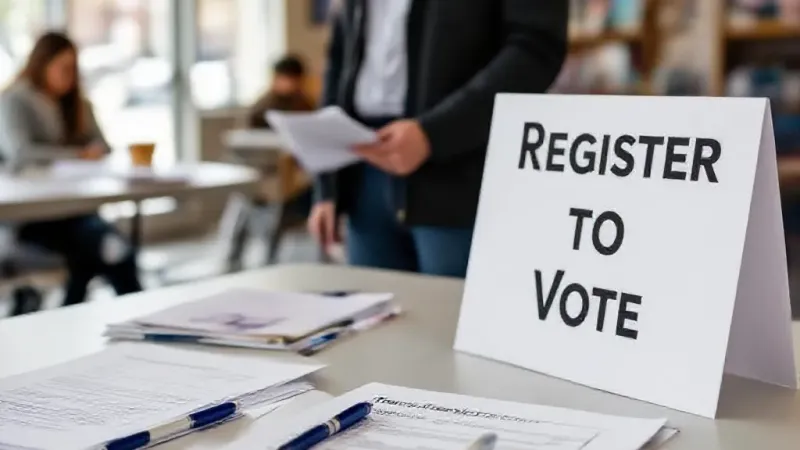
Hundreds of Hoosier candidates are set to compete for elected offices in the midterm general election on Tuesday, Nov. 3. Residents of Terre Haute, Vigo County, and the Wabash Valley will have the opportunity to cast their ballots for federal, statewide, and legislative positions, with important deadlines for voter registration and early voting approaching.
To participate in the upcoming election, unregistered voters must sign up by Monday, Oct. 5. There are three methods available for registration. Online registration can be completed by visiting IndianaVoters.in.gov and clicking the “apply now” button within the “register to vote” box. A valid Indiana driver’s license or state identification card is required for online registration, with applications due by 11:59 p.m. on Oct. 5.
In-person registration is available at county clerk or voter registration offices, or at the Indiana Election Division. "Full-service" voter registration agencies, such as an Indiana Bureau of Motor Vehicles branch, also offer registration services when obtaining personal identification documents. In-person applications are due by the close of business on Oct. 5.
For those preferring to register by mail, a voter registration form can be completed and sent to a county clerk’s office, voter registration office, or the Indiana Election Division. Indiana’s form or the federal form can be downloaded, or obtained at the aforementioned government agencies. Mailed applications must be postmarked by Monday, Oct. 5. This deadline is distinct from the Oct. 22 deadline for absentee ballot applications. Local election administrator contact information is available on the registration form or online. Voters who move after the registration deadline should contact their county election office to determine where and how they can vote, as some may qualify to vote in their former precinct after completing an affidavit.
On Election Day, polls will be open from 6 a.m. to 6 p.m. local time. Several options exist for voting before Election Day. In counties that operate as “vote center” counties, voters can cast their ballots at any designated vote center, rather than being restricted to a specific neighborhood polling place. Residents can determine if their county uses vote centers by visiting the Indiana secretary of state’s website.
Hoosiers will elect federal representatives to serve in Washington, D.C., with all nine of Indiana’s U.S. House seats on the ballot this fall. Neither of the state’s two U.S. senators are up for election this cycle. At the state level, while Governor Mike Braun and Lt. Governor Micah Beckwith are not seeking re-election in this midterm cycle, three other statewide executive offices are on the ballot: secretary of state, treasurer, and comptroller.
GOP Secretary of State Diego Morales was reportedly knocked out of reelection contention at the Republican convention in June. The next Secretary of State will be chosen from a four-way race featuring Republican Max Engling, Democrat Beau Bayh, Libertarian Lauri Shillings, and Lincoln Party independent Greg Ballard. For Treasurer, Republican Daniel Elliott is challenged by Democrat Coumba Kembe. The race for Comptroller pits Republican Elise Nieshalla against Democrat Jessica Bailey and Libertarian John Schick.
Within the legislative branch, also known as the Indiana General Assembly, all 100 members of the House of Representatives and half of the 50 state senators are up for election this year. State senators serve four-year terms, while representatives serve two-year terms. The General Assembly is responsible for drafting and passing laws, which the governor can sign or veto. A gubernatorial veto can be overridden by a majority of all elected members in each chamber. The legislative branch also drafts the state’s two-year budget during “long sessions” in odd years, typically running from January to April. “Short sessions,” held in even years, usually commence in January and conclude in early March. Only the governor has the authority to call the General Assembly into a special session if deemed necessary.
Indiana’s judicial branch is tasked with interpreting the state’s constitution and laws. This branch includes the Indiana Supreme Court, the Court of Appeals, the Tax Court, along with superior, circuit, probate, small claims, city, and town courts. Trial courts are where cases are initially heard and disputes resolved. Appellate courts, which include the Supreme Court, Court of Appeals, and Tax Court, review decisions when a party challenges a ruling, often on grounds of a legal error. The Tax Court, established in 1986, specifically hears cases arising under Indiana tax laws, including appeals of final decisions from the Indiana Department of State Revenue or the Indiana Board of Tax Review, and certain appeals from the Department of Local Government Finance. Courts possess the authority to strike down laws found to be unconstitutional. Supreme Court justices and Court of Appeals judges are appointed by the governor from nominees submitted by the Judicial Nominating Commission. Voters then decide whether to retain these judges and justices in office through retention elections held at the first statewide general election after they have served two full years, and every 10 years thereafter if retained. There is a mandatory retirement age of 75 for Court of Appeals judges and Supreme Court justices.
Further information, including specific ballot details, can be found at IndianaVoters.in.gov.