
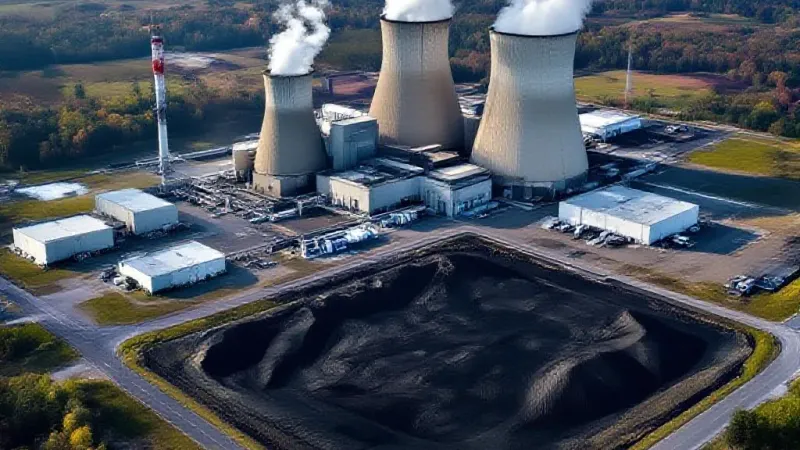
Federal officials announced Tuesday that Indiana’s proposed takeover of toxic coal byproduct permits is ready for federal approval. If finalized, the program would become the largest in the country, shifting oversight of hazardous coal combustion residuals (CCR) disposal from the federal government to the state.
Coal combustion residuals, primarily produced by burning coal in power plants, include powdery fly ash and glassy boiler slag. These byproducts contain dangerous contaminants such as mercury, cadmium, and arsenic. While the U.S. Environmental Protection Agency (EPA) currently regulates CCR disposal in most states, the agency has been increasingly encouraging states to assume responsibility. Indiana is the tenth state with proposed or final approval for managing CCR disposal units.
U.S. Environmental Protection Agency Deputy Administrator David Fotouhi told reporters at an Indianapolis news conference that giving states the lead "helps ensure that those who understand local conditions the best, and their local energy needs, are in the driver’s seat to oversee the process." Fotouhi and state leaders maintain that the move would improve health and environmental results. Fotouhi added that the step "reinforces, not weakens, safeguards for human health and the environment," and allows Hoosiers to decide what is best for Indiana.
Governor Mike Braun similarly stated that Indiana’s approach "strengthens environmental safeguards and keeps permitting decisions here at home," promising "greater control, transparency, and accountability in how coal ash is managed." He also indicated that a state-run program will offer "stronger tools to prevent groundwater contamination, protecting drinking water where these impoundments are, and it gives us agility in terms of staying on top of it."
Last year, Governor Braun issued an executive order that bans new state environmental regulations more stringent than federal versions unless explicitly required by law or deemed necessary by the governor’s office. Similar "no more stringent than" limits are also present in Indiana law. When asked how the state would improve outcomes given these restrictions, Braun responded, "To just assume that there would be anything being laxed or done at a lower level of concern or quality would be a bad assumption."
The Indiana Department of Environmental Management (IDEM) would oversee the CCR program. The agency estimates that approximately 100 CCR units across Indiana would require permitting under the proposed rule. The takeover has been in the works for several years, with IDEM staff writing the regulations between 2021 and 2024. The Indiana Environmental Rules Board gave final approval in late 2025.
The program includes comprehensive requirements for design, operation, groundwater monitoring, closure, recordkeeping, and financial assurance. Indiana submitted its CCR application to the EPA in June. The proposed rule will be published in the federal register on Wednesday, beginning a 60-day public comment period. IDEM anticipates federal approval as soon as February or March.
Once the new program goes into effect, CCR units will have 180 days to submit applications for permits. IDEM will then be required to approve or deny applications for new CCR units or major changes within one year. Minor changes will have a 180-day deadline for the agency’s decision.
Implementing the state program will come with an estimated $1.3 million in personnel costs, including inspectors, engineers, and geologists, along with expenses for equipment, training, and conferences. Governor Braun confirmed that IDEM is already "moving forward with staffing" for the program. IDEM Commissioner Clint Woods stated that the program will be largely funded by permit fees, with additional income from federal grants and state coffers. Woods also noted that Indiana would continue to advocate with the EPA to ensure that, as the biggest program in the country, it receives its fair share of resources.