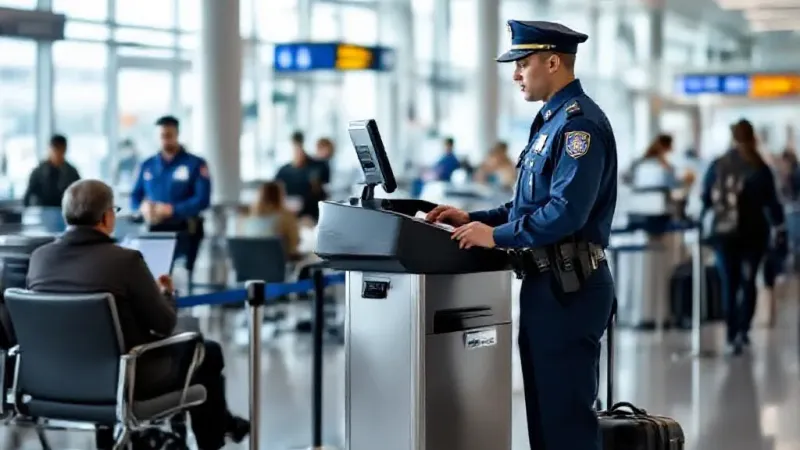
WASHINGTON – Transportation Security Administration (TSA) officers will no longer be permitted to sit while checking identification at U.S. airport checkpoints. The agency and a major union, the American Federation of Government Employees TSA Council 100, confirmed the decision on Tuesday, September 29.
The American Federation of Government Employees TSA Council 100, which represents TSA workers, criticized the move. The council stated the chairs “serve as basic ergonomic and safety support for officers that stand and walk on hard surfaces all day,” characterizing the decision as a “disregard for workers’ rights and safety.”
In response, the TSA confirmed its decision to remove chairs from checkpoints. The agency stated that this change "reinforces both our security posture and our commitment to hospitality by having these officers on their feet and alert." The TSA further noted that all officers must meet fitness for duty requirements to be capable of performing their vital national security function.
This policy change comes amidst previous discussions and proposals related to the TSA's operations and workforce. Earlier in April, President Donald Trump had proposed significant cuts to the agency's annual budget, suggesting a reduction of just over $1.5 billion, or approximately 20%, from the TSA's funding. His proposal also included cutting more than 9,400 workers from the agency, which employs about 60,000 individuals overseeing airport security operations.
President Trump also advanced a proposal to require smaller airports to transition to private security contractors. This move, if implemented, was projected to reduce the TSA payroll by more than 4,500 jobs, marking a preliminary step toward privatizing the agency originally established following the September 11, 2001, attacks. Currently, approximately 20 airports, including those in San Francisco, Kansas City, and Sarasota, Florida, have utilized private security screeners for several years.
Recent leadership changes within the TSA have also been notable. In August, the U.S. Senate voted to confirm David Cummins, a senior vice president of Serco, a UK-headquartered multinational firm managing public services for governments, to lead the TSA. This confirmation followed a period where President Trump had fired previous TSA head David Pekoske on his first day in office in 2025 and did not nominate a replacement for 16 months.
Furthermore, a lengthy government shutdown this past spring had a significant impact on TSA operations. During the shutdown, 50,000 TSA workers went without pay for a period of six weeks, leading to major disruptions at airports nationwide, including security wait times that extended to four hours or more.