
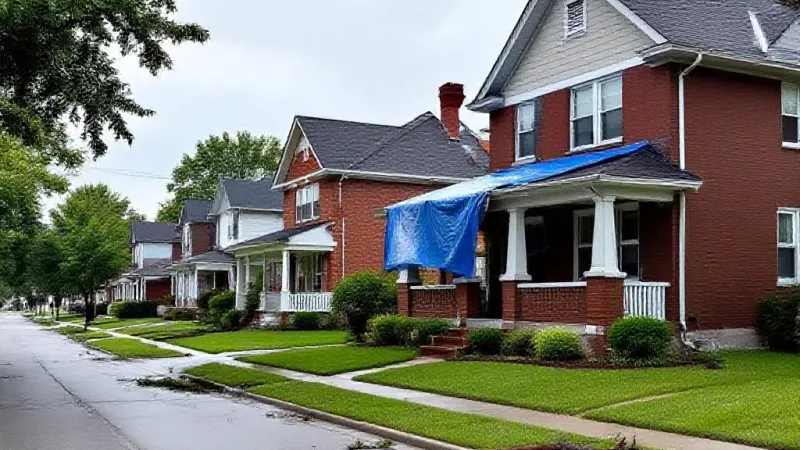
The first $1 million in state disaster aid has now been sent out to Hoosiers affected by severe storms that began on August 11, according to the Indiana Department of Homeland Security (IDHS). These funds, distributed via paper checks or direct deposits, mark an expedited effort to assist residents with immediate needs such as shelter, clothing, food, and replacing essential items like mattresses.
As of Wednesday, the IDHS had approved $1.7 million in assistance for approximately 260 homes. After approval, the Indiana Comptroller’s Office processes these payments. So far, the average payment issued to affected households is around $4,000.
To help Hoosiers faster, IDHS eliminated its standard 90-day review period for these applications. Jonathan Whitham, Executive Director of Homeland Security, emphasized the agency's commitment to speed. Whitham noted, "we’re throwing everything out that we can" to streamline the process, adding that the state is exploring future adjustments to statutes to enable even quicker responses. This expedited approach allowed over a million dollars to be disbursed within roughly two and a half to three weeks from the decision to accelerate the process.
The severe storms, which commenced on August 11, caused extensive damage across large areas of the state, including widespread flooding and wind destruction. President Donald Trump subsequently approved a major disaster declaration for 21 counties, with the possibility that additional counties could still be added for assistance.
The sheer volume of applications underscores the scale of the disaster. More than 40,000 applications for state aid have been reviewed to date. Of these, approximately 12,000 were deemed ineligible, primarily because the address provided was not the applicant's primary residence or the county was not yet eligible for assistance. IDHS has also encountered issues such as requests to replace non-essential items like televisions, and has even identified some AI-generated damage photos among applications.
Whitham described this event as "the biggest event for (State Disaster Relief Fund) history." The State Disaster Relief Fund typically receives about $1 million annually, primarily from taxes on fireworks. Due to the unprecedented scale of the August storms, IDHS, in consultation with Gov. Mike Braun and legislative fiscal leaders, established a $5,000 payment limit per household. This decision was made despite state law allowing a maximum of $25,000, as the fund lacked sufficient money to cover the estimated $80 million in damages, even with the reduced cap. Whitham clarified that the $25,000 maximum is typically reserved for "longer-term recovery things" in traditional disaster scenarios where funding is more readily available.
To address the significant shortfall, state budget officials are continuously moving money into the relief fund from contingency accounts and reserves on a rolling basis, ensuring funds are available as needed. Whitham also indicated that the majority of longer-term recovery needs, such as replacing heating and air conditioning units or removing drywall and mold, are expected to be met through federal assistance programs.
The agency reports that the number of new applications has slowed, though about 15,000 applications are currently in a holding pattern, awaiting additional information such as proof of damage or banking details. IDHS has actively supported residents by hosting multiple one-stop shops and mobile registration intake centers. These centers allow storm-affected residents to access local, state, and federal resources in a single location, facilitating the application process. Processing these applications remains a top priority for the agency.