
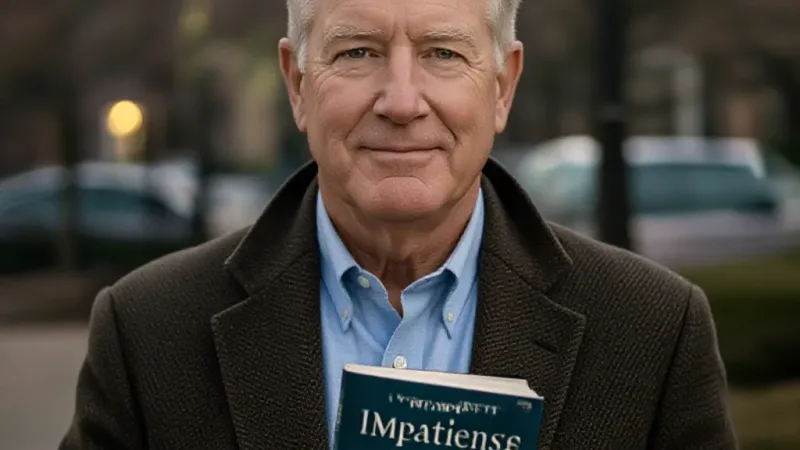
Former two-term Indiana Governor and current Purdue University President Mitch Daniels is set to release his new book, “Impatience is a Virtue: A Life Where the Buck Stops,” on Sept. 15. The 505-page memoir provides Daniels' perspective on his career, spanning various public and private sector roles.
According to a release from Lyons Press, Daniels has driven “transformative change” in America's public, private, and nonprofit sectors, including at the White House, Eli Lilly and Company, Indiana's Governor's Office, and Purdue. The book reflects on his journey from being the Harley-Davidson riding grandson of a Syrian immigrant to becoming, as described by Lyons Press, “one of the nation’s most admired leaders.”
Daniels recounts his decision to accept a position in the Reagan White House in late 1984, stating the opportunity proved “irresistible.” He notes that by that time, Ronald Reagan had not only secured re-election but had also “revived the American economy, and even more important, the American spirit.” Daniels writes that Reagan had “ushered in a conservative Camelot” and he wanted to be directly part of it.
Reflecting on President George W. Bush’s decision to invade Iraq in 2003, Daniels states he does not dispute the “negative judgment” history has reached regarding the decision. He also notes he was “never privy” to the information upon which the decision was based. However, Daniels rejects “the slander that President Bush knowingly lied to justify invading Iraq.” He writes that the Bush he knew would be precluded from such an action by his upbringing and faith. Daniels suggests Bush may have allowed anger over the attacks of Sept. 11, 2001, to cloud his judgment or feared the consequences if Saddam Hussein possessed weapons of mass destruction. He accepts that Bush "believed he had good reason to act as he did” at the time of the decision.
In 2003, Daniels departed Washington, D.C., to run for governor of Indiana. He describes returning his rental furniture during the day, sleeping on a rug, and then strapping his belongings onto his convertible for the 600-mile drive home. After crossing from D.C. into Maryland, Daniels recounts calling Bill Oesterle, telling him he would give Oesterle a month to prepare, as his gubernatorial campaign was “a go.”
The loss of the Indiana House to Democrats in 2007 marked a challenging period for Daniels' governorship. He recalls House Speaker B. Patrick Bauer telling reporters at a weekly press availability that Daniels would only remain governor for “two more years.” This period, Daniels writes, was marked by difficult polls, the loss of the House, negative media stories, and frequent editorial criticism. He admits to lashing out privately at figures like journalist Matt Tully, ally Luke Kelly, and “even those closest to me.”
Daniels also reflects on his public demeanor, stating he “almost always managed to behave myself publicly.” He once told the press that his “only health risk was bleeding to death from biting my lips so hard.” He adds that when he did speak out publicly, he “always seemed to get the short end of the media stick.”
The Republican landslide election of 2010, Daniels writes, “completed the reshaping of the state’s electoral map” that began with his 2004 win. He notes that few Democrat officeholders were left in Southern Indiana, with similar turnovers in local offices. This victory, he states, initiated an era of “trifecta government” in Indiana, referring to one-party control of the governorship and both legislative houses. While welcome to the party in power, Daniels describes such a situation as “at best a mixed blessing” for the quality of campaigns and governance over the long term.
Daniels details his decision not to run for president in 2012, explaining that his family, including his wife Cheri and their four daughters, “hated the idea and were petrified at the prospect.” Despite testing their attitudes and explaining the support and prospects of success, Daniels notes that “Nothing made a dent in their fear or opposition.” He writes that all political factors were aligned, but his family was not. Daniels states there is “one sentence a father has no answer for” — “‘Daddy, please don’t.’”.
Regarding Indiana's Religious Freedom Restoration Act (RFRA), Daniels admits he “was dead wrong” in thinking the uproar would subside, given numerous precedents for the law. He watched “sympathetically” as Governor Mike Pence faced scrutiny from ABC commentator George Stephanopoulos on a Sunday talk show, noting Pence “floundered badly” when repeatedly asked if the bill would permit discrimination against gay individuals. Daniels attributes the intensified opposition in Indiana to evolving public attitudes about homosexuality and certain nuances in the Indiana bill. He also suggests that Pence's manner of celebrating a “temporary victory” contributed to the negative outcome.
On Donald Trump's selection of Mike Pence as his running mate in 2016, Daniels observes that the two had “no personal relationship but a persuasive political rationale.” He describes Pence as offering a “reassuringly traditional conservative record” to complement Trump's “new, more populist brand of Republicanism.” Daniels also notes that Pence's decision to run for governor had proven successful, adding an executive credential to his legislative background.
Daniels also addresses his decision not to run for the U.S. Senate in 2023. He states that a “shot-across-the-bow threat from (David) McIntosh’s group” would have been “an incentive, not a deterrent” if he had any real interest in the Senate, and adds, “And we would have won.” He points to a survey at the time showing high recognition and favorable ratings, which he attributes to his work at Purdue as well as his time in elected office. Daniels also notes that at the time, outside his district, Jim Banks had little public recognition.