
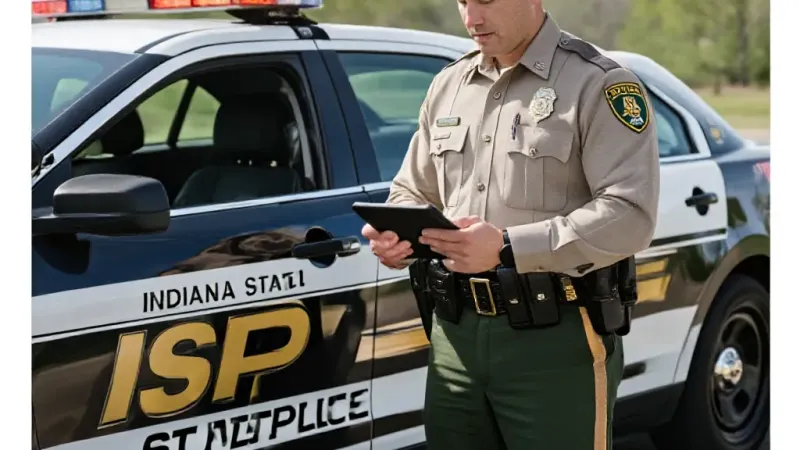
The Indiana State Police (ISP) is seeking nearly $30 million in federal funding to acquire surveillance technology, vehicles, and investigative tools. These resources would enhance the agency’s collaborations with federal immigration authorities across the state.
Hoosier law enforcement officials submitted an application in July for funding through the U.S. Department of Justice’s fiscal year 2026 Bridging Immigration-Related Deficits Experienced Nationwide (BIDEN) program. This program, created by Congress through the One Big Beautiful Bill Act, offers financial assistance to state and local law enforcement agencies that participate in, or commit to join, the U.S. Immigration and Customs Enforcement’s (ICE) 287(g) program. The 287(g) initiative trains and authorizes state and local officers to perform specific federal immigration functions under ICE supervision.
According to ISP’s report to the State Budget Committee, the federal request totaled $29,069,985. A revised budget and federal application form included in the same submission put the total at $30,269,985. As of September 8, the application remained pending, and the Justice Department had not yet announced funding recipients, according to Sgt. John Perrine, an ISP spokesperson. The application does not propose any state or local matching funds, nor does it plan to add new employees.
While the agency describes the project as broader than solely immigration enforcement—stating the equipment would support work involving drugs, human trafficking, organized crime, violent offenses, child exploitation, fugitives, and forensic investigations—immigration enforcement is explicitly integrated throughout the application. One stated goal of the project is to "increase the quality, speed, and consistency of immigration-related enforcement support."
ISP reported that 185 troopers were trained and certified by ICE under the 287(g) agreement as of July, a number that rose to 217 by September 8, Sgt. Perrine confirmed. These certified troopers include road officers, detectives, interdiction personnel, narcotics investigators, and commercial motor vehicle enforcement officers. As of July, ISP personnel had participated in 276 detainments under this agreement, with certified troopers conducting at least two enforcement efforts with ICE each quarter and regularly working alongside municipal officers who support the initiative. ISP did not provide updated figures on detainments or how many resulted in transfers to ICE custody.
The agency’s Intelligence Fusion Center also plays a role, receiving immigration-related tips and forwarding vetted information to ICE, U.S. Border Patrol, and Homeland Security Investigations. The application indicates the center had received 604 such tips, including 573 about individuals, 14 concerning Indiana Department of Correction parolees, 14 tied to addresses, and three regarding businesses. ISP officials noted in the application that these figures show a "sustained and growing federal-support workload."
This federal funding would build upon an existing immigration partnership within ISP. An executive order issued in 2025 by Gov. Mike Braun directs state law enforcement agencies to cooperate with ICE to the maximum extent permitted by law, including through agreements that authorize officers to perform certain immigration functions. ISP described its need for the money as "immediate and statewide," intending the grant to help sustain and expand its 287(g) participation, federal task force work, and immigration-tip screening. Sgt. Perrine stated that all equipment and supplies would "augment enforcement efforts in every segment of public safety regardless of crime or threat," including immigration enforcement, and that better-equipped troopers would benefit all Indiana communities.
Most of the requested money, about $21.6 million, would be used for equipment purchases. The revised budget also allocates $6.8 million for technology and other contractual costs, $1.2 million for construction or renovation, approximately $476,000 for supplies, and $204,200 for travel and training.
Specific proposed purchases include $10.56 million for 176 vehicles, budgeted at $60,000 each. ISP indicated these vehicles, both marked and unmarked, would replace or expand its fleet and be shared across the agency, supporting investigators, uniformed troopers, interdiction teams, narcotics units, and officers involved in 287(g) activities. The application also lists covert surveillance cameras, license-plate and vehicle-identification tools, cellular-location systems, armored vehicles, drones, firearms, ballistic vehicle upgrades, protective equipment, K-9 resources, and forensic technology.
The revised budget adds $1.42 million for 20 covert camera units, intended to address aging infrastructure and limited mobile surveillance capacity that can delay time-sensitive operations. Another $3 million would cover three years of an investigative platform used to process cellphone information and court-order data, identifying people, addresses, vehicles, financial flows, cryptocurrency activity, and connections among people or organizations. Other technology includes five cell-site simulator systems totaling $1.5 million, 10 portable cell-site simulator backpacks for $570,000, and 20 license-plate camera systems for $300,000.
ISP officials stated that the location and surveillance technology could be used to investigate drug and human trafficking, organized crime, and immigration-related matters, though the application does not specify how much equipment would be solely devoted to immigration enforcement. Sgt. Perrine noted that court authorization is required for cellular-location records, and ISP policy requires a legitimate law enforcement purpose and documented inquiry for license-plate reader data, which is generally purged after 30 days unless preserved in an investigative file. The Fusion Center is authorized to share information with government or private-sector personnel for official public safety or justice purposes and must maintain an audit trail.
Cole Varga, CEO of Indianapolis-based Exodus Refugee Immigration, expressed concern that the application’s promises to sustain and expand ISP’s federal partnerships contradict public statements portraying immigration enforcement as a limited part of the proposal. Varga told the Indiana Capital Chronicle that ISP is "downplaying their involvement" and that claiming no staffing connected to the agreement is misleading, as federal funding for equipment could free up other agency dollars for immigration-related work.