
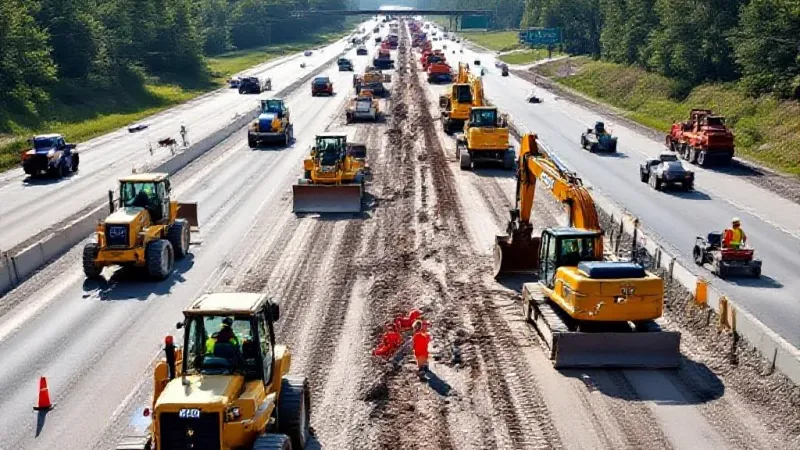
Indiana's highway construction costs have surged dramatically, with state and industry leaders pointing to both inflation and the state's strategic ambitions as key drivers. The average cost to construct a centerline mile of interstate highway reached $46 million in the state's 2026 fiscal year, which concluded in June.
This figure represents a nearly 450% increase from the $8.4 million average recorded in the 2015 fiscal year, according to data shared during a late August meeting of the State Budget Committee. "That’s unbelievable," Sen. Fady Qaddoura, D-Indianapolis, commented on the soaring costs.
These figures specifically account for centerline miles built as part of full reconstruction or added travel lane projects. Indiana Department of Transportation (INDOT) spokeswoman Natalie Garrett clarified that costs encompass lane replacements and additions, widened and rebuilt shoulders, barrier walls and guardrails, traffic and drainage control, materials, and labor. Garrett cited inflation in material costs, supply chain shortages, and even the pandemic as contributing factors.
While other states are also experiencing higher costs—Kentucky Transportation Cabinet spokesman Allen Blair acknowledged increases but noted the difficulty in comparing project-specific costs across states—Indiana's approach is described as "unique" by Garrett. Unlike other states that may prioritize highway maintenance or federal bridge funding, Indiana is focused on building additional capacity.
Brian Gould, the executive director of Build Indiana Council, stated that Indiana is now undertaking larger projects, which inherently lead to higher costs. He noted a shift in the industry's work since the General Assembly approved a significant road-funding law in 2017. Initially, contractors primarily performed "pretty basic" resurfacing, involving milling off and replacing a few inches of asphalt. However, Gould explained, the state has since transitioned to a variety of major capital projects, frequently located near large metropolitan areas. According to Gould, "Those are really your two biggest factors when it comes to cost: what what do you want us to build, to what scale, and where do you want it located at?"
INDOT's average costs for the last fiscal year included two particularly complex undertakings: Revive I-70 in Wayne County and the Safer Drive 65 project in Scott and Clark counties. Garrett explained that "Both of these projects require complex maintenance of traffic set-ups to sustain high traffic volumes on I-70 and I-65 during construction, which adds to the cost."
Urban construction projects are typically more expensive due to increased front-end engineering required to manage higher displaced vehicle traffic, more lanes of work, the need for more barriers to protect workers, and pricier materials. Gould further elaborated that major interstate and bridge work is "very heavy on the steel and very heavy on the concrete side," two materials that have seen substantial cost increases over the past five years due to inflation, tariffs, and high demand. The Federal Highway Administration's national highway construction cost index, which tracks price changes for materials like asphalt, base stone, and concrete, rose by over 60% from 2020 through 2025.
Road builders in Indiana are also facing competition for essential resources. Gould noted that the state's booming economy has led to other large developers, such as data centers, consuming significant amounts of concrete, steel, and asphalt, creating competition for materials and making equipment challenging to find.
To manage these escalating expenses, INDOT employs several strategies. Garrett detailed that projects are competitively bid, with the agency generally selecting the lowest-priced proposal. INDOT also utilizes "alternative delivery" methods, which involve contractors in the pre-construction phase. This early involvement, particularly on complex projects, is designed to enhance risk mitigation, accelerate delivery, increase industry collaboration, incentivize design innovations, and provide greater cost certainty, according to Garrett.
The agency also bundles projects within contracts based on timing, location, and other requirements, which Garrett said helps not only with spending but also by limiting traffic impacts on drivers. Furthermore, Indiana is the only state in the country that maintains 20-year asset management plans for infrastructure such as pavement, bridges, and drainage. INDOT uses these plans to "intervene early and often" with lower-cost maintenance, thereby preventing assets from deteriorating to the point of requiring more expensive total replacement, Garrett affirmed.