
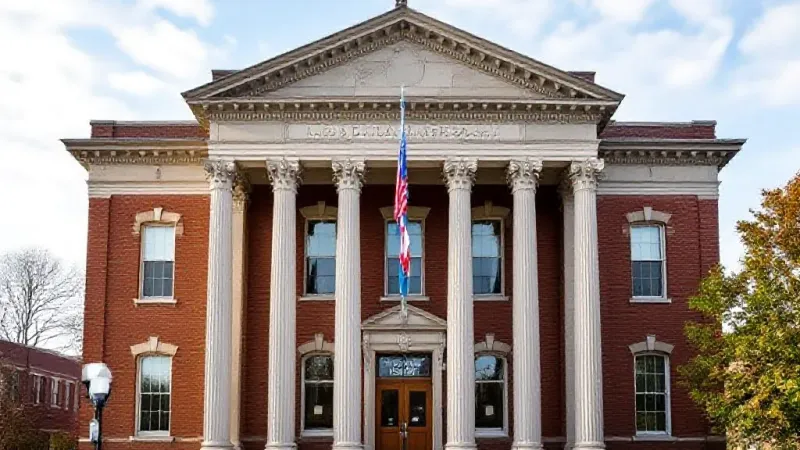
A federal judge on Thursday dismissed a complaint filed by voting rights organizations that challenged Indiana's citizenship verification statutes, citing the groups' failure to demonstrate organizational injury under new legal precedent. The decision by U.S. District Court Judge Matthew P. Brookman gives the plaintiffs 28 days to refile their complaint.
The lawsuit, filed last October in the U.S. District Court for the Southern District of Indiana, was brought by the League of Women Voters of Indiana, Common Cause Indiana, Hoosier Asian American Power, and Exodus Refugee Immigration. These groups alleged that recently approved state laws discriminate against Hoosiers who have become U.S. citizens. They contend that these laws subject naturalized citizens to verification processes that natural-born citizens do not face.
The plaintiffs also asserted that the laws have forced them to divert significant money and resources to counteract their impacts on the people they serve, distracting from their core missions. According to the plaintiffs, this diversion constituted a direct injury.
However, Judge Brookman stated in his Thursday order that these alleged injuries do not align with recent precedent established by a 2024 U.S. Supreme Court decision, FDA v. Alliance for Hippocratic Medicine. The court confirmed that an organization cannot “manufacture” its own standing by “divert(ing) its resources in response to a defendant’s actions.”
Judge Brookman explained that these allegations no longer suffice to establish organizational standing under the new test. He noted that plaintiffs must now demonstrate that the challenged statutes directly affect or interfere with their "core business activities," rather than just their organizational missions, to illustrate their injuries. He opined that the plaintiffs failed to allege what their "core business activities" are, thus not passing this prong of the AHM organizational-standing test.
More than 60% of immigrant Hoosiers challenged under a recent proof of citizenship law have had their voter registrations rejected or canceled by the state of Indiana, with several hundred cases still pending. Secretary of State Diego Morales has stated that the statutes are intended to boost election security.
In addition to dismissing the complaint without prejudice, Judge Brookman denied a motion for a preliminary injunction. Such an injunction would have temporarily paused enforcement of the laws. The judge noted that with the complaint dismissed, no claims remained pending upon which to grant injunctive relief.
The nonpartisan organizations were represented by the Chicago Lawyers’ Committee for Civil Rights, Lawyers’ Committee for Civil Rights Under Law, and Daniel Bowman and William Groth of Bowman Legal Services, LLC.
Ami Gandhi, director of the Midwest Voting Rights Program with Chicago Lawyers’ Committee for Civil Rights, expressed disappointment with the ruling. She noted that without relief from the court, eligible voters—specifically naturalized and derived U.S. citizens—will be forced to overcome “additional hurdles” simply to remain registered to vote. Gandhi added that Indiana’s new documentary proof of citizenship requirements have already misidentified hundreds of eligible U.S. citizens as potential noncitizens, jeopardizing their right to vote. She pointed out that state and federal law already prohibit noncitizens from voting, and every voter affirms their citizenship when registering. Gandhi stated that the legal teams will continue to work with their clients to explore the best legal pathway forward to protect all eligible voters before the November midterm election.