
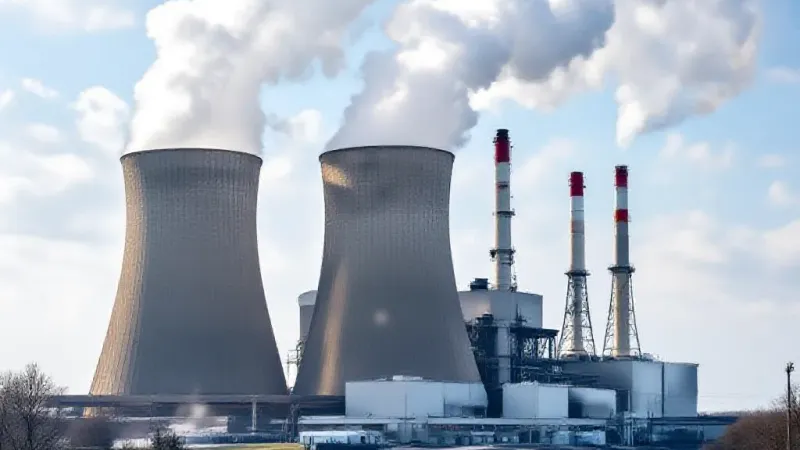
Two Indiana coal-burning power plants, CenterPoint Energy’s F.B. Culley generating station in Warrick County and Northern Indiana Public Service Co. (NIPSCO)’s R.M. Schahfer generating station, remain open under a federal order from the Trump administration, despite previous plans for their retirement. A recent ruling by a federal appeals court in a similar case in Michigan could challenge the basis for keeping these Indiana facilities operational in the future.
The U.S. Department of Energy (DOE) has repeatedly extended the lifespans of coal plants in five states, including Indiana, asserting that the electricity generated at these facilities is necessary to address a national energy emergency. However, on Friday, a three-judge panel at the U.S. Court of Appeals for the District of Columbia issued a ruling that expressed skepticism regarding the department’s justifications for maintaining the J.H. Campbell Coal Plant online in Michigan. The court determined that the department had exceeded the emergency authority granted by the Federal Power Act.
The Michigan ruling stemmed from a challenge initiated by the Michigan attorney general. In that case, the Campbell plant's owner, Consumers Energy, had announced plans to retire the facility in 2021. Both the Michigan Public Service Commission, which oversees energy companies in the state, and the Midcontinent Independent System Operator (MISO), the energy grid operator for the central United States, had approved the plant’s retirement. MISO, in particular, had determined that the retirement would not violate its reliability criteria for the energy grid.
Judge Cornelia Pillard, writing for the panel, noted that states have "exercised authority, preserved by the Federal Power Act, to regulate in-state power plants" for the benefit of their citizens for almost a century. The ruling emphasized that states bear the primary responsibility for planning and averting reliability risks and for deciding which generation resources to build, expand, reduce, or shut down.
The Trump administration first issued orders extending the operation of six plants across Indiana, Pennsylvania, Colorado, Washington, and Michigan in December—just days before CenterPoint Energy and NIPSCO were scheduled to retire their coal-powered F.B. Culley and R.M. Schahfer generating stations in Indiana. The latest renewal of this federal order for the Indiana plants runs through September 19.
CenterPoint Energy released a statement acknowledging the U.S. Court of Appeals’ decision involving Consumers Energy’s J.H. Campbell plant. The company stated it is evaluating the potential implications for its Culley 2 generating unit in Warrick County. CenterPoint clarified that the court’s decision does not alter the U.S. Department of Energy’s directive for Culley 2, and the company confirmed it would continue to comply with that directive. CenterPoint also affirmed its commitment to prioritizing affordability and reliability for its southwestern Indiana customers, noting there are no direct bill impacts to customers at present. The company has filed requests with both the Federal Energy Regulatory Commission (FERC) and the Indiana Utility Regulatory Commission (IURC) concerning compliance with the DOE’s order and the subsequent recovery of associated costs. In a February letter, CenterPoint Indiana Region President Michael Roeder had described the coal-fired Culley plant as an "inefficient and increasingly unreliable asset," accounting for less than 1% of the region’s installed electric capacity.
NIPSCO also issued a statement indicating it is reviewing the U.S. Court of Appeals’ decision regarding the Department of Energy’s order for Consumers Energy. NIPSCO stated its focus remains on safely and reliably serving customers while continuing to comply with applicable legal and regulatory requirements.
Executives from NIPSCO and CenterPoint told the Indiana Utility Regulatory Commission the month after Roeder's letter that the fuel, chemicals, staffing, and upgrades required to keep these units operational are costly. The Federal Energy Regulatory Commission authorized MISO to adopt tariffs, allowing NIPSCO and CenterPoint to recover these ongoing costs. An analysis from the Sierra Club, which filed a lawsuit challenging the emergency orders, estimated that keeping NIPSCO’s Schahfer plant online could cost consumers a net of $174,000 daily, while CenterPoint’s Culley plant could cost consumers $21,000 each day.
The ruling, while specific to Michigan, establishes a precedent regarding the limits of the Department of Energy’s emergency authority under the Federal Power Act, which could have future ramifications for the continued operation of coal plants in Indiana and other states affected by similar federal orders.