
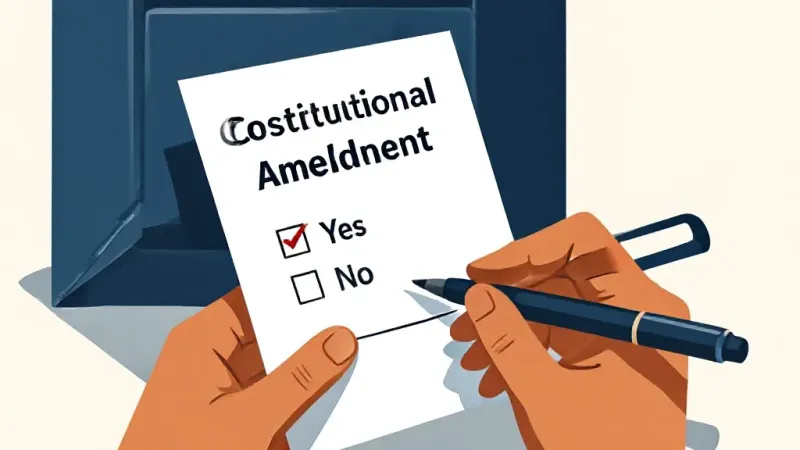
Early voting has begun in Indiana, presenting Hoosiers with Public Question 1, a proposed amendment to the state's constitution concerning pretrial detention. This question seeks to expand the circumstances under which judges can deny bail, potentially leading to people remaining jailed before trial, even before any conviction.
The measure, appearing on ballots statewide in a yes-or-no format, proposes a change to Article 1, Section 17 of the Indiana Constitution. Currently, this section defines the right to bail for individuals accused of crimes other than murder and treason, granting them a constitutional right to seek release while awaiting trial.
If Public Question 1 passes, judges could deny bail entirely if prosecutors demonstrate strong evidence supporting a charge and convince a judge that no release conditions could ensure community safety. This represents a substantial shift in Indiana's constitutional rights, rather than a minor policy adjustment.
The legislative path for this amendment included Senate Joint Resolution 1, which passed the General Assembly in both 2023 and 2026, thereby placing it on the November ballot. Lawmakers also enacted Senate Enrolled Act 2, which outlines how courts would implement this expanded authority, and Senate Enrolled Act 3, which established the specific language voters will see on their ballots.
Concerns have been raised regarding the breadth of this expanded power. An amendment introduced during a recent legislative session that would have excluded individuals charged with misdemeanors or Level 6 felonies, Indiana's lowest felony level, from these expanded bail restrictions was rejected by lawmakers. Unlike states such as Texas and Ohio, which specify particular violent or sexual offenses to which such restrictions apply, Indiana's legislation leaves the scope alarmingly ambiguous.
Under the proposed process, judges could consider factors like employment, financial resources, family history, and community ties when making bail decisions. This raises questions about potential bias and the consistency of these standards across the state, particularly concerning how people experiencing poverty, housing instability, or challenging family circumstances might be impacted, potentially resulting in unequal treatment before any trial has occurred.
The proposal comes amidst Indiana's ongoing incarceration crisis. According to the Prison Policy Initiative, approximately 46,000 individuals are incarcerated across Indiana's prisons, jails, immigration detention, and juvenile facilities. Within Indiana's 92 county jails, about 65% of the individuals held have not been convicted of any offense; they are presumed innocent and are awaiting trial.
Indiana's jails are also characterized by chronic overcrowding and documented deplorable conditions. These circumstances make pretrial detention particularly troubling, as individuals enduring these environments may face destabilizing impacts, potentially losing their livelihood, stable housing, access to vital healthcare, support for their loved ones, and their practical ability to actively prepare their legal defense. These effects can be devastating, especially for someone who may ultimately be cleared of all charges.
The primary argument for Public Question 1 cites public safety as its rationale. However, data from various sources challenges the notion that expanding bail denial is necessary to address this concern. The Indiana Lawyer investigated data from the Indiana Office of Court Services, finding that 98.6% of assessed “high-risk” people released pretrial did not commit a new violent crime while on release. This percentage was even higher for moderate-risk individuals (98.9%) and low-risk individuals (99.4%).
Furthermore, judges already possess several tools to address public safety concerns before release, including no-contact orders, supervision, and electronic monitoring. Indiana law already grants judges the authority to increase or revoke bail when an individual poses a risk to public safety. The Indiana Criminal Justice Institute also found that approximately 93% of people released before trial in 2025 were not rearrested or charged with a new offense. Even among the remaining 7%, a new charge does not automatically equate to a conviction.
Constitutions are designed to safeguard the freedom and rights of individuals, particularly when they are most vulnerable. The presumption of innocence is a fundamental principle that should apply universally. The decision Hoosiers make on Public Question 1 carries consequences far beyond November, shaping the rights of individuals awaiting trial and influencing the future of justice in Indiana.